Group size: 2-10 | Time 1 hour | difficulty: Medium
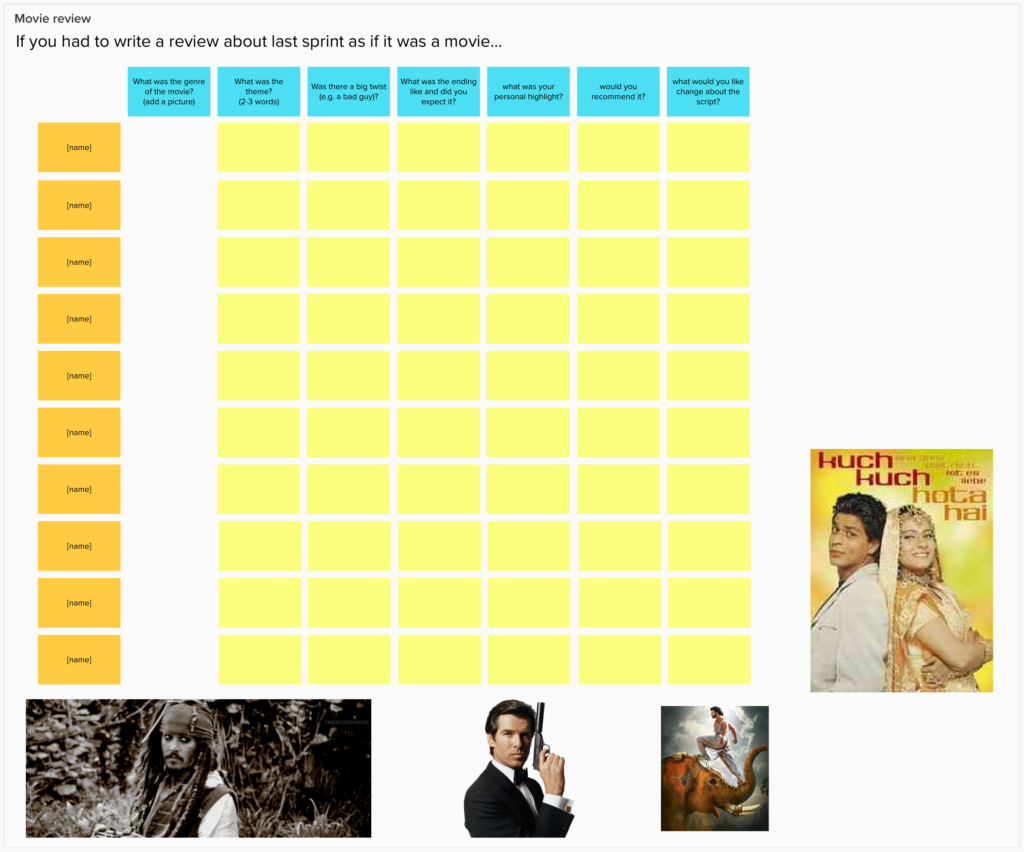
- What was the genre of the movie? The main goal here is to identify how people looked at the sprint. This questions also activates the brain to look at work in a different way. [examples: horror, comedy, drama, fantasy, …]
- What was the theme? Here people can think of how they experienced the sprint. [examples: love story, good vs evil, sacrifice, family drama]
- Was there a big twist? In a sprint you start with assumptions, the goal of this question is to identify where something unexpected happened during the sprint that made us reconsider our commitment.
- What was the ending like, and did you expect it? Here the focus is on the Sprint Goal. In essence you could translate it into did we reach our sprint goal and was that already to your expectation or not?
- What was your personal highlight? What did you learn, or which exciting moment did you experience in this sprint?
- Would you recommend it? Is next sprint would go like the current one would that be fine? This is a simple yes or no question.
- What would you like to change about the script? Based on previous question if you could change anything about last print which new (idea, suggestion, adjustment) would you implement?
Performing the Movie Time retrospective
[TIP 1] Although I always urge to start with a nice Check-in, in this retrospective you may leave it since it is already so much fun! Furthermore, the conceptual thinking in this retrospective already showcases the personal touch of people.
- Give the team a few minutes to fill the board. Important in this retrospective format is that everyone understands what is meant with the questions. First go over all the questions before you let them fill it in. Also give the desired answer format… a picture, a sentence, yes/no. Since this is a conceptual retrospective, it is important that the participants understand the rule of the game. [TIP 2] Add pictures, this might be hard for people at first, but it gives so much joy and fun.
- Discuss the answers with each other. Since this retrospective format can give a lot of diversity in the answers the skill here is to find the 1) general feeling and 2) the big diverse. As an example, if one person says the sprint was a love story and the other one a horror that is interesting to explore. If you give everyone a turn this can take hours. During the retrospective we’re ofcourse looking for ways to improve ourselves therefore in this format it is useful to ask people that would like to change something; that wouldn’t advise this sprint or that learned a lot or less to see how they can work towards a better movie next time.