Group size: 2-10 | Time 1 hour | difficulty: Easy
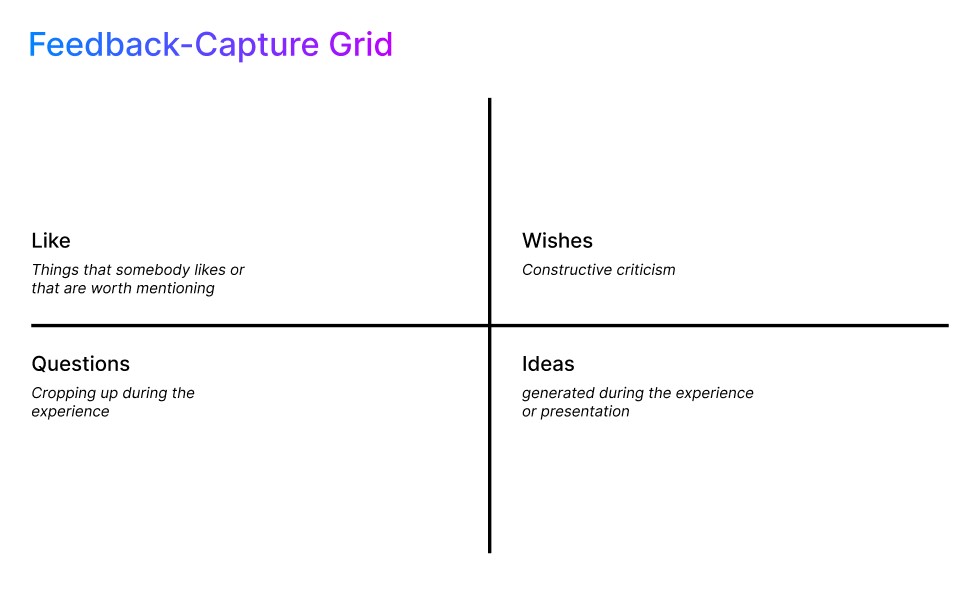
The feedback grid is my all-time favorite (default) retrospective format. We all would like to make inspiring retrospectives that motivate and stimulate the teams to get to good conversations. Nevertheless, sometimes we just don’t get the time to create such a thrilling format. In a lot of organizations and teams we tend to go to columns; mad, sad, glad; like, learned, longed for; etc. Although this format is in essence not different, I prefer this one since there is no, to little judgment in all the words and they invite to an open conversation.
- Like(d) (glad / enjoyed): What gives you joy when looking back at last sprint? Goal is to give each other compliments or create awareness of the good job you guys did last sprint.
- Wishes (needs to change / mad / longed for): What could be done better to make your work live easy? Focus on how to make things better. Think of a constructive way of giving feedback. ´Last sprint I noticed … and I would like to have it changed so that …’. Unlike Ideas in this quadrant, you don’t have to give an answer to your issue. You may do so ofcourse, but the main goal is to speak out any frustration or issues that might hinder performance in the future
- Questions (remarks / unclarities): To which questions do you need an answer to do your job? This is a quadrant that often doesn’t get filled up a lot. But it might be that stakeholders or users didn’t give clarity yet on topics or that your team is waiting on a response and that is slowing down the team.
- Ideas (options /possibilities): What insight or idea would you like to share with the group to enhance our way-of-working? In a team there are always so many ideas and possibilities to get to the finish line. In this quadrant people can add their ideas to improve the team.
Performing the Feedback grid retrospective
- Always start your retrospective with a Check-in. Personally, when performing this retrospective, I like to spend a bit more time on the check-in… 10-15 minutes. Since it is important have a good vibe in the team I like to start with a more personal question and let the team answer with a picture or discuss the results. Think of: What did you had for breakfast? Favorite holiday location? Best movie you have seen? See my Check-in page for more ideas.
- Give the team 7 minutes to fill the board. Like other formats I shared I prefer being in the office putting post-its up. Nevertheless, you can use an online tool to create this feeling online. [TIP 1] let people add their name or initials to the post-it for easy and quick discussion later. [TIP 2] When you see people are nearly finished and not much is added to the board already group the post-its to have a quicker overview and so you can easier deep dive in important topics.
- Walk through the quadrants with main focus on Wishes. Starting off with the Like quadrant it would be advisable to just mention the different topics over there and ask the team who would like to elaborate on what is mentioned there. [TIP 3] In this quadrant it is fine if you already summarize a bit based on own experiences. This is what I have seen … and indeed this and this went well … Although the goal is not that you speak a lot this can help putting focus on the important part the Wishes! When it comes to the whishes try to group the ones that relate. Always check with the people if your assumption is right and they can indeed be seen as one. Give the floor here to the team. What did you mean with this post-it? Deep dive to get to the root cause. [TIP 4] Try to directly incorporate the questions and ideas. Often you see those are related to wishes. In this way you can keep within time limits. [TIP 5] In case you get in a time squeeze just say so and mention that people can read what is there and if there is a point that someone wants to elaborate on or that is speaks for itself.
- Close off with a summary of the session and recap the action points. At the end of the session always close together so people can finish the session in the session and don’t rush away with a lot on their mind. What helps is having noted down the action points so you can go over them.
Retrospectives are to learn from the past but build towards the future. Trust and fun are the most important factors when it comes to building a team. Keeping that in mind will always result in great outcomes!